Hosting services with real-time fast performance?


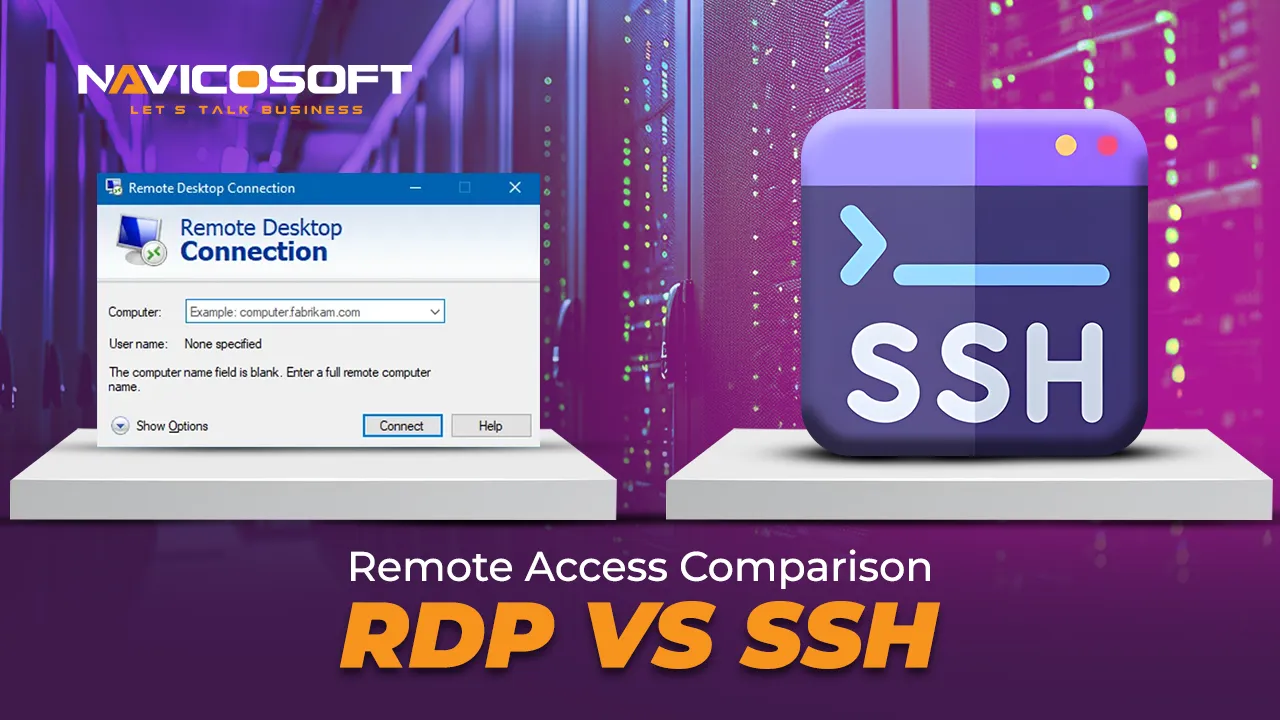
Remote Access Comparison: RDP vs SSH
With the advent of remote work and hybrid environments, the demand for secure and reliable ways to give desktop access to employees is increasing. However, two solutions are common for this purpose, one is Secure Shell (SSH) and the other is Remote Desktop Protocol (RDP). Both solutions give remote access, but they are different by means of security,scalability, performance, and management.
Why do businesses compare RDP vs SSH?
A comparison of RDP vs SSH helps to determine a reliable solution that best fits an organization’s remote work, security, scalability, and budget requirements. RDP gives graphical remote desktop access, while SSH provides secure command-line control. Familiarity among their differences helps organizations increase productivity, boost cybersecurity, support remote administration, and improve network performance.
A quick look at RDP:
RDP hosting is an acronym for Remote Desktop Protocol. It is a Microsoft-developed protocol that enables users to remotely access and control a Windows computer or server over the internet. It transfers the desktop interface to a remote device. This allows users to work on files, apps, and systems just like they were physically present at the computer.
RDP Architecture and Communication Process:
Remote Desktop Protocol operates by sending screen displays, keyboard inputs, and mouse actions between a client device and a remote computer by using the internet. It makes a secure remote session that allows users to access apps, files, and system resources from another location.
Advantages of RDP:
- Full graphical desktop access
- Centralized remote administration
- Efficient low-bandwidth performance
- Multi-user session support
- Device and printer redirection
- File and clipboard sharing
- Strong Windows integration
- Simplified IT management
Use Cases of RDP:
- Remote employee access
- IT help desk support
- Server administration
- Remote software management
- Virtual desktop environments
- Data center management
- Business continuity operations
- Remote training sessions
A quick look at SSH:
Secure Shell (SSH) is a cryptographic network protocol developed for safe communication over an unsecured network. It is often deployed for remote login and administrative command execution, overtaking older and insecure protocols like Telnet and rsh. SSH transfers encrypted data between the client and server for high confidentiality and integrity.
How Does SSH Work?
SSH leverages a client-server model to make a secure encrypted connection between local and remote systems through the internet. It verifies users via passwords, SSH keys, or multi-factor authentication before giving access. Generally, SSH works via command-line interfaces and securely transmits commands, files, and configuration data. This protects the communication process.
Advantages of SSH:
- Strong encrypted communication
- Secure remote command execution
- Lightweight network usage
- SSH key authentication support
- Secure file transfer capabilities
- Cross-platform compatibility
- Reliable remote server management
- Reduced attack surface
Use Cases of SSH:
- Linux server administration
- Remote command execution
- Secure file transfers
- Network device management
- Cloud infrastructure management
- DevOps automation tasks
- Remote troubleshooting
- Secure system configuration
RDP vs SSH: feature comparison
User interface and accessibility:
RDP gives a full graphical desktop interface with mouse and keyboard interaction, This makes navigation easier for general users.
SSH often deploys a command-line interface. This solution needs IT expertise and provides faster remote management for technical professionals and developers.
Security and encryption standards:
RDP supports encoded communication, network-level verification, and multi-factor authentication for safe remote access.
SSH is developed with powerful encryption and secure verification mechanisms by default. This makes it more reliable for secure server management and safe remote communication.
Performance and bandwidth utilization:
RDP transmits graphical desktop data, which can use higher bandwidth during remote sessions.
SSH leverages lightweight text-based communication. This yields lower bandwidth utilization and optimal performance on slow or unstable network connections.
Operating System compatibility:
RDP is usually optimized for Windows environments. However, supported apps are available for Linux and macOS systems.
SSH provides broader cross-platform compatibility and is vastly supported across Linux, Unix, macOS, Windows, and cloud-based infrastructures.
Resource consumption:
RDP sessions often need more system resources as they process graphical user interfaces and multimedia content.
SSH leverages least CPU, memory, and network resources. However, it mainly manages text-based commands and lightweight remote management operations.
Session management capabilities:
RDP powers persistent desktop sessions, multi-user access, session reconnection, and shared desktop environments for team-based management.
SSH allows different secure terminal sessions simultaneously. This helps administrators to manage servers and execute remote commands efficiently.
Automation and scripting support:
RDP primarily works on graphical remote access and manual managerial tasks.
SSH supports automation, scripting, remote execution, and DevOps workflows. This makes it more effective for automated server management and infrastructure tasks.
Does RDP and SSH work together?
RDP and SSH usually function together in business environments to deliver flexible remote access and administration. SSH is usually used for secure command-line management, automation, and server configuration. However, RDP gives graphical desktop access for Windows systems. The combination of both solutions enhances functional efficiency, security, remote troubleshooting, and infrastructure management functionality.
Future trends of RDP and SSH:
- Cloud-based remote access adoption
- Zero Trust security implementation
- Advanced multi-factor authentication
- AI-powered threat detection
- Improved hybrid work support
- Enhanced DevOps automation
- Secure remote access gateways
When to choose RDP and SSH?
Selection between RDP and SSH depends on business size, security requirements, budget, and performance demands.
When to choose RDP:
RDP is a perfect option for small to medium organizations that require budget-friendly, simple, and instant remote access to shared systems.
When to Choose SSH:
It is best suited for system administrators managing remote servers, performing configuration changes, and executing secure, lightweight remote operations efficiently.
Verdict:
RDP is an affordable option and simple. However, SSH is perfect for secure command-line administration and automation. Selection between the RDP vs SSH relies on use case, security demands, and infrastructure needs. Many businesses leverage both solutions to get optimal remote access efficiency and control.