Hosting services with real-time fast performance?


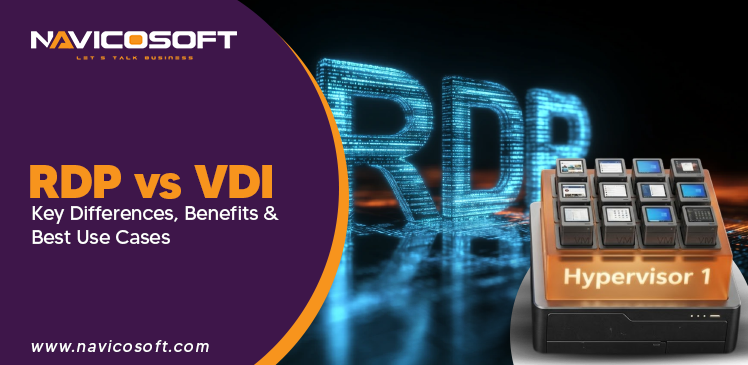
RDP vs VDI: Key Differences, Benefits & Best Use Cases
With the evolution of remote work and hybrid environments, the need for secure and reliable ways to deliver desktop access to employees is increasing. Therefore, two solutions are common for this purpose, one is Virtual Desktop Infrastructure (VDI) and the other is Remote Desktop Protocol (RDP). However, both provide remote access, but they differ in security, scalability, performance, and administration.
Why do businesses compare RDP vs VDI?
A comparison of RDP vs VDI helps to determine the right solution that best fits an organization’s remote work, security, scalability, and budget demands. RDP hosting provides least costs and easy deployment. On the contrary to this, VDI gives stronger security, centralized administration, and perfect user isolation for huge or highly regulated organizations.
What is RDP?
RDP is an acronym for Remote Desktop Protocol. It is a Microsoft-developed protocol that enables users to remotely access and control a Windows computer or server over the internet. It transfers the desktop interface to a remote device. This allows users to work on files, apps, and systems just like they were physically present at the computer.
Essential RDP architecture components:
- RDP client
- Remote desktop host/server
- RDP protocol
- Network connection
- Authentication system
- Remote Desktop Gateway
- Licensing server
- Encryption and security controls
Standard RDP Deployment Models
- Direct peer-to-peer remote desktop access
- Remote Desktop Services (RDS) deployment
- Virtual machine–based remote desktops
- Cloud-hosted RDP environments
- Gateway-based secure remote access
- Multi-user session host deployment
- Hybrid on-premises and cloud RDP setup
Benefits of using RDP:
- Low preliminary setup cost : RDP deploys integrated Windows features. This reduces hardware, software, and deployment charges for businesses.
- Simple remote access solution : RDP gives instant remote connectivity. This allows users to access desktops and applications from anywhere easily.
- Native Windows integration : RDP operates directly with Windows environments. This feature ensures compatibility, shared administration, and easier management control.
What is VDI?
VDI is an acronym for Virtual Desktop Infrastructure. Thus, this is a virtualization technology that hosts desktop environments on single-point servers or cloud infrastructure. Users can remotely access these virtual desktops from any compatible device while apps and data remain securely stored in the organization’s environment. VDI enhances integrated management, security, scalability, and virtual team support for businesses.
How does VDI work?
VDI operates by hosting virtual desktops on integrated servers within a data center or cloud environment. So, users can connect remotely via compatible devices and access personalized desktop sessions over the internet. The infrastructure administers computing resources, security, apps, and data centrally. This increases scalability, performance, and access management.
Role of Virtual Machines in VDI:
Virtual machines (VMs) have pivotal role in VDI:
- VMs host single virtual desktop environments for users.
- Virtual machines can isolate user sessions for perfect security and stability.
- These machines can enable centralized desktop management and updates.
- VMs can allocate computing resources efficiently on the basis of workload.
- Virtual machines provide remote connectivity across different devices and locations.
Persistent vs Non-Persistent Desktops:
Persistent Desktops: These are user-specific virtual desktops that retain settings, files, and modifications between sessions permanently.
Non-Persistent Desktops: These are temporary virtual desktops that reset after each session. Non-persistent desktops give clean,consistent environments for every login.
Non-Persistent Desktops: These are temporary virtual desktops that reset after each session. Non-persistent desktops give clean,consistent environments for every login.
Benefits of using VDI:
- Stronger security and isolation : VDI secures data integrated on servers. This reduces endpoint risks and improves user isolation.
- Integrated IT administration : Technical teams manage updates, patches, and configurations from a single-location infrastructure.
- Better compliance assistance : VDI helps organizations fulfill regulatory demands via centralized access, tracking, and reliable data protection.
RDP vs VDI: key differences
Infrastructure and architecture :
- RDP provides access to users to a single shared server session.
- VDI delivers individual virtual machines for each user’s desktop environment.
Security and data protection:
- RDP relies on session-level security.
- VDI uses centralized storage for data with advanced isolation and improved protection controls.
Performance and resource allocation :
- RDP shares server resources among multiple users.
- VDI delivers dedicated virtual resources to individual desktops for constant performance.
Scalability and user management :
- RDP expands via session hosts.
- VDI expands by allocating extra virtual machines and managing users centrally.
Customization and user experience :
- RDP provides confined personalization.
- VDI delivers complete desktop customization and constant user-specific environments across devices.
Cost and licensing requirements :
- RDP is a more budget-friendly option with simpler licensing.
- VDI needs higher infrastructure and licensing investments.
Use cases of RDP:
- Remote IT support and troubleshooting
- Accessing office desktops from home
- Managing servers and remote systems
- Lightweight remote work for small teams
- Temporary or occasional remote access needs
Challenges and limitations of RDC:
- Enterprise remote workforce environments
- Secure access for regulated industries
- Large-scale centralized desktop management
- BYOD (Bring Your Own Device) programs
- Consistent desktops for global teams
When to opt for RDP or VDI?
Selection between RDP and VDI relies on business size, security needs, budget, and performance requirements.
RDP is a perfect option for small to medium organizations that require budget-friendly, simple, and instant remote access to shared systems.
VDI is an ideal choice for enterprises demanding reliable security, dedicated virtual desktops, scalability, and integrated management for huge or remote teams.
Conclusion:
By weighing RDP vs.VDI, both solutions enable remote desktop access but offer different business purposes. RDP is an affordable option and simple. However, VDI gives better security, scalability, and personalization. Having understanding about their differences helps businesses select a reliable solution to increase performance, security, and long-term technical efficiency.