Hosting services with real-time fast performance?


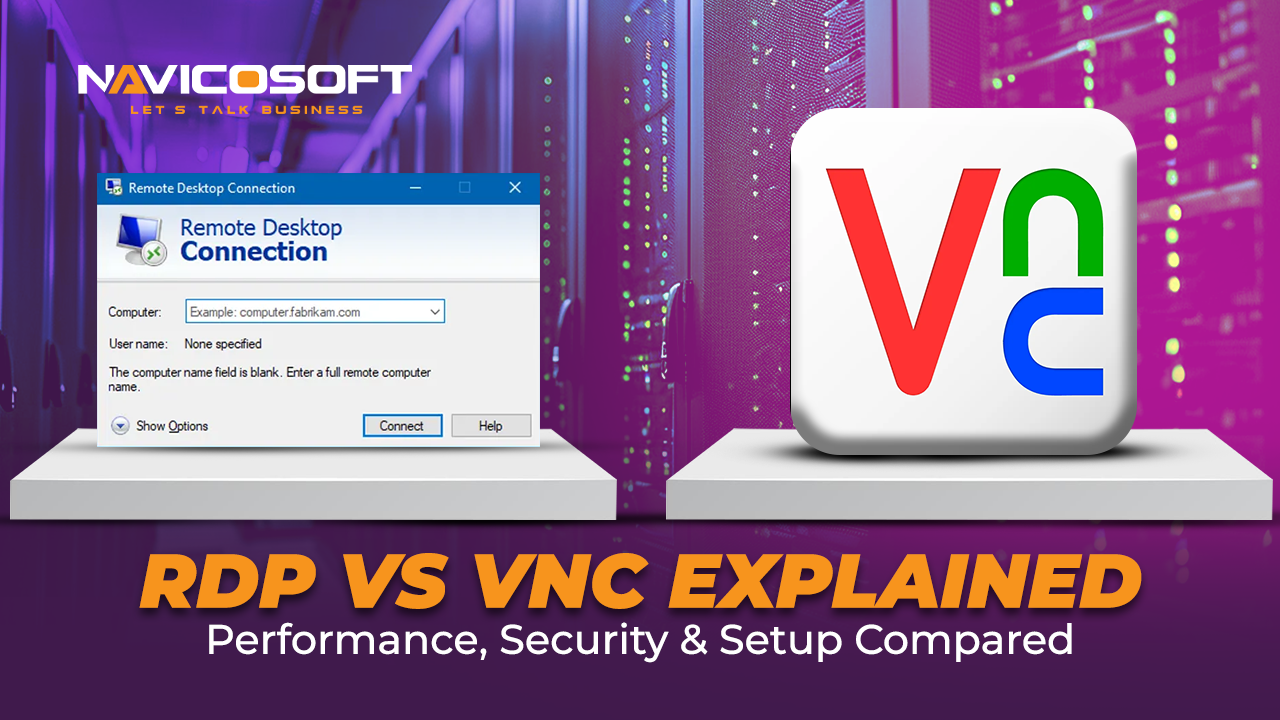
RDP vs VNC Explained: Performance, Security & Setup Compared
Businesses can manage systems, facilitate remote workforce, and access devices from any location by using remote access technologies. Among the leading remote access solutions are Remote Desktop Protocol (RDP) and Virtual Network Computing (VNC). Therefore, both of these solutions provide remote access, but they are different by means of performance, security, setup complexity, and user experience. A complete understanding of RDP vs VNC helps businesses optimize remote access performance and efficiency.
What is RDP?
The protocol developed by Microsoft enables users to remotely access and control another computer over the internet. Buy RDP delivers secure communication, resource sharing, and integrated remote management.
How does RDP work?
Remote Desktop Protocol operates by sending screen displays, keyboard inputs, and mouse actions between a client device and a remote computer by using the internet. It makes a safe remote session that allows users to access apps, files, and system resources from another location.
Key features of RDP:
- Multi-user sessions: RDP enables different users to access and manage systems simultaneously.
- File sharing: Remote Desktop Protocol provides easy transfer of files between local and remote devices.
- Clipboard redirection: This remote access technology allows copying and pasting content across limited remote sessions.
- Media streaming: RDP enables audio and video playback throughout remote desktop sessions reliably.
- Multi-monitor support: Remote Desktop Protocol enables users to operate systems across diverse screens in remote environments.
Common use cases of RDP:
- Remote IT support and troubleshooting.
- Accessing office computers from home.
- Server administration and maintenance.
- Managing cloud-based virtual machines.
- Supporting remote and hybrid work environments.
What is VNC?
VNC is an acronym for Virtual Network Computing. Thus, this is a remote desktop technology that enables users to view and control another computer with the help of graphical screen sharing. It operates across multiple operating systems and provides remote access, IT support, system tracking, and shared technical resolution over local networks or the internet.
How does VNC work?
Virtual Network Computing operates by transferring keyboard inputs, mouse actions, and display screen updates between a VNC server and a viewer app. Thus, the server shares the remote device’s screen. On the other hand, the viewer enables the users to communicate with and control the system remotely with the help of a network connection.
Key features of VNC:
- Cross-platform access: VNC provides remote connection across various operating systems and devices efficiently.
- Input control support: Virtual Network Computing delivers complete control by using keyboard and mouse from remote system.
- Lightweight deployment setup: The installation and configuration of Virtual Network Computing is easy and simple that requires minimal system resource needs.
- Multi-user viewing: VNC supports different users viewing or tracking in the same remote session.
- Network connectivity support: Virtual Network Computing operates over both local networks and internet connections.
Common use cases of VNC:
- Remote IT support and troubleshooting.
- Accessing home or office computers remotely.
- System tracking and administration.
- Collaborative technical assistance and training.
- Managing servers and network devices remotely.
RDP vs VNC: Key Differences
RDP vs VNC: Key Differences:
- RDP deploys session virtualization.
- VNC shares the desktop screen that is different in architecture, performance, security, and scalability for remote access.
Connection Architecture:
- RDP makes virtual sessions on the server.
- VNC transfers raw screen data from the host machine directly.
Performance and speed:
- RDP is lightning fast due to optimized data management.
- VNC performs slowly under heavy graphical workloads.
Security and encryption:
- RDP includes features like built-in encryption and authentication.
- Generally, VNC requires third-party tools for secure connections.
Bandwidth usage:
- RDP uses the least bandwidth by deploying compression.
- VNC needs higher bandwidth for consistent screen updates.
User experience and Interface:
- RDP provides efficient and responsive user interaction.
- VNC may deliver slow performance.
Cross-Platform compatibility:
- RDP is primarily focused on Windows.
- VNC focuses on different operating systems like Linux and macOS.
Scalability for Businesses:
- RDP gives better scalability in enterprise environments.
- VNC is more perfect for small-scale deployments.
What are common security risks for RDP and VNC?
Common security risks of RDP:
- Poor or reused passwords
- Brute-force login attacks
- Unpatched software vulnerabilities
- Unverified remote access
- Exposed RDP ports on public networks
- Malware or ransomware attacks
Common security risks of VNC:
- Outdated VNC software vulnerabilities
- Weak access control configuration
- Lack of multi-factor authentication
- Unverified remote access
- Malware infections via remote connections
- Open ports vulnerable to attacks
When to choose RDP and VNC?
You can opt for Remote Desktop Protocol for secure, high-performance remote access in Windows environments, business management, and remote work.
You can select Virtual Network Computing for cross-platform access, screen sharing, and team-based troubleshooting. VNC performs perfectly for IT support, training, and remotely accessing diverse operating systems.
Closing words:
In comparison of RDP vs VNC, both remote access solutions provide reliable accessibility. However, a perfect choice can make a difference. so , you can opt for a solution on the basis of security, performance, compatibility, and business needs.
RDP is a perfect option for small to medium organizations that require budget-friendly, simple, and instant remote access to shared systems.